
On a premium project, you rarely lose the spec to a competitor. You lose it later, in a value engineering meeting, when a QS trying to close a budget gap swaps your product for a cheaper one that “does the same job” on paper. Nobody in that room heard your pitch. If your product doesn’t survive that meeting, the sale you thought you’d won never actually happened.
This is worth naming because it changes what actually needs defending. Value engineering isn’t personal, and it isn’t really about brand. As a project moves from concept to construction documentation, someone gets asked to find savings, and they go line by line looking for anything that can be swapped without anyone noticing. On a standard project, that’s a hard search: most items are structural, or tied to compliance, and cutting them creates a problem somebody has to answer for. On a luxury project, it’s an easy one. A hand-finished stone wall, a designer sanitaryware range, a bespoke lighting package: these read as decorative choices, and decorative choices are exactly what a spreadsheet treats as optional.
That’s the pattern to watch for. Anything specified mainly for how it looks gets flagged before anything specified for what it does. A stone-clad reception wall competes, in that meeting, against a porcelain panel that mimics the same finish for a fraction of the cost. Nobody is weighing hand-finished stone against tile on its merits. They’re weighing a line item that names the finish against one that just says “cheaper,” and unless someone gave them a reason those aren’t the same, they’ll take the cheaper one every time.
The fix isn’t a better pitch. It’s a different kind of case, attached to the spec itself, not just delivered in a meeting. Give the specifier something that answers the swap on function, not just appearance: the expected lifespan against the cheaper option, the maintenance schedule, the warranty terms, a wear or fire rating if it’s relevant to the space. This is most of what we cover in The Art of Selling Luxury: the value that survives a budget review isn’t the value the client felt when they saw the sample. It’s the value someone can point to on paper, months later, when they weren’t in the room for the original pitch.
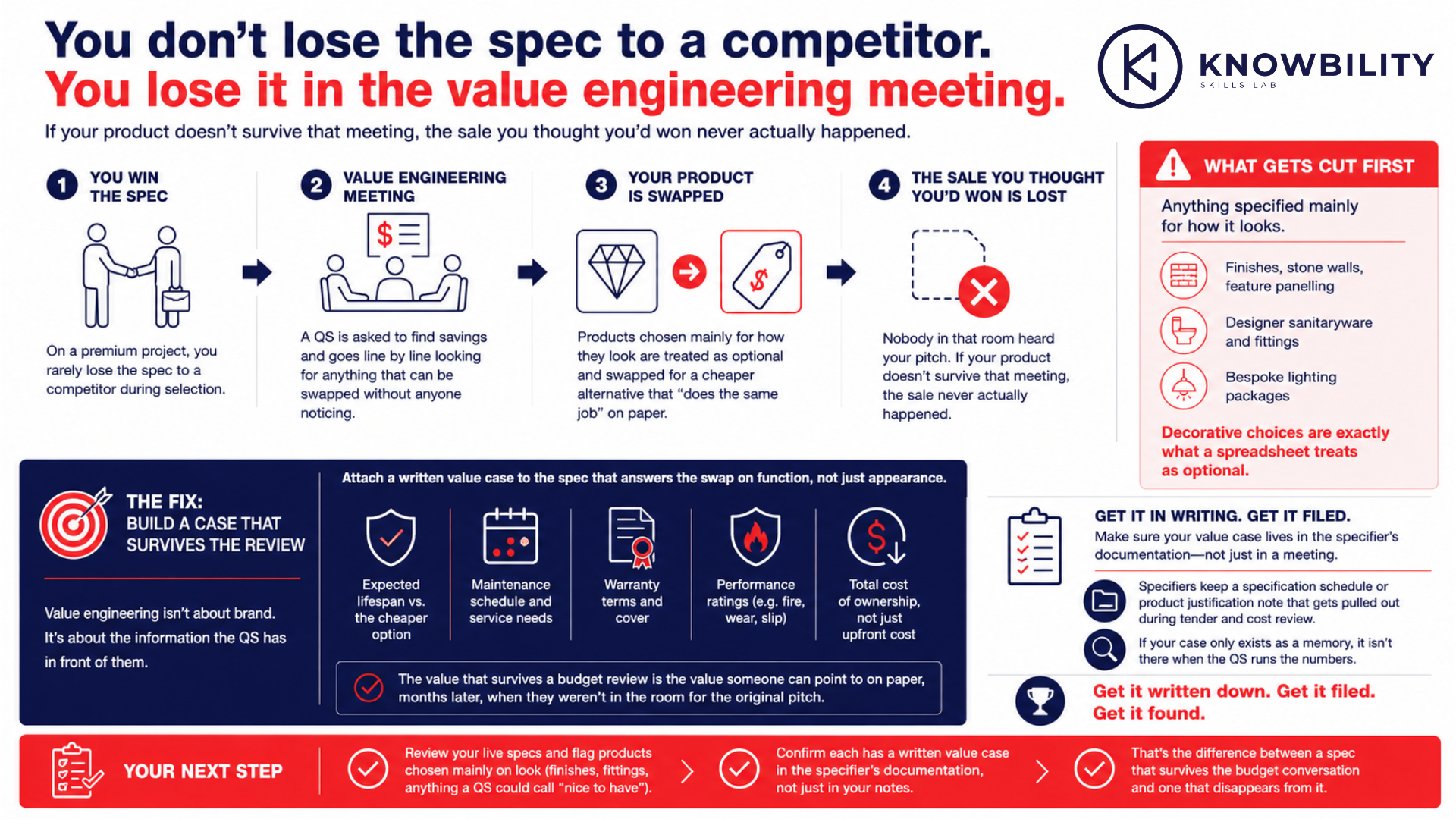
That case also has to end up in the right place. Most specifiers keep a specification schedule or a product justification note that gets pulled out during tender and cost review. If your value case only exists as a memory from a meeting six months ago, it isn’t there when the QS runs the numbers. Get it written down, and get it into whatever document the specifier files, so it’s sitting there waiting to be found instead of relying on someone remembering to defend you.
Before your next value engineering review lands on someone else’s desk, go through your live specs and flag the products that were chosen mainly on look: finishes, fittings, anything a QS could plausibly call “nice to have.” Check each one has a written case sitting in the specifier’s documentation, not just in your last meeting notes. That’s the difference between a spec that survives the budget conversation and one that quietly disappears from it.
Want more like this? Our monthly newsletter covers practical tips, real stories from the industry, and what’s changing in construction sales and marketing: Sign Up Here